
Inspiring Speech:The Great Dictator
The Final Speech from The Great Dictator
- լսել խոսքը(ճառը) յութուբյան տեսանյութից
- կարդալ, թարգմանել, քննարկել
- սովորել նոր բառերը
- ընտրել հատված և ձայնագրել
- Առանձնացնել այն նախադասությունները, որտեղ կան բառերի և հանգերի կրկնություններ (repetition and rhythm),օրինակ՝ “Machine men with machine minds and machine hearts!”
- առանձնացնել այն նախադասությունները,որտեղ Չապլինը իր խոսքով հույս է արթնացնում մարդկանց մեջ։(hope)
- առանձնացնել այն նախադասությունները, որ հույզեր են առաջացնում:(emotions)
I’m sorry, but I don’t want to be an emperor. That’s not my business. I don’t want to rule or conquer anyone. I should like to help everyone — if possible — Jew, Gentile — black man — white. We all want to help one another. Human beings are like that. We want to live by each other’s happiness — not by each other’s misery. We don’t want to hate and despise one another. In this world there is room for everyone. And the good earth is rich and can provide for everyone. The way of life can be free and beautiful, but we have lost the way.
Greed has poisoned men’s souls, has barricaded the world with hate, has goose-stepped us into misery and bloodshed. We have developed speed, but we have shut ourselves in. Machinery that gives abundance has left us in want. Our knowledge has made us cynical. Our cleverness, hard and unkind. We think too much and feel too little. More than machinery we need humanity. More than cleverness we need kindness and gentleness. Without these qualities, life will be violent and all will be lost….
The aeroplane and the radio have brought us closer together. The very nature of these inventions cries out for the goodness in men — cries out for universal brotherhood — for the unity of us all. Even now my voice is reaching millions throughout the world — millions of despairing men, women, and little children — victims of a system that makes men torture and imprison innocent people.
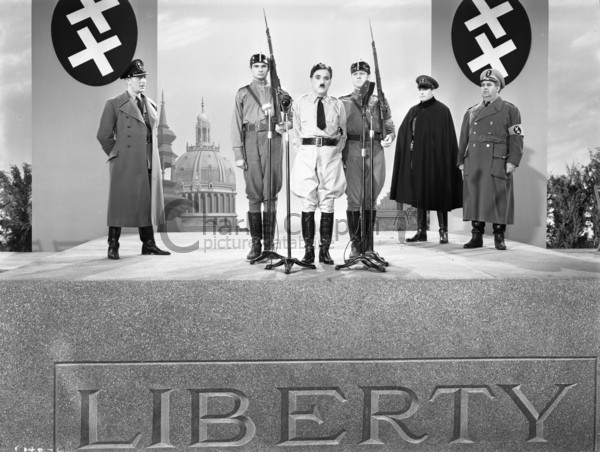
To those who can hear me, I say — do not despair. The misery that is now upon us is but the passing of greed — the bitterness of men who fear the way of human progress. The hate of men will pass, and dictators die, and the power they took from the people will return to the people. And so long as men die, liberty will never perish. …..
Soldiers! don’t give yourselves to brutes — men who despise you — enslave you — who regiment your lives — tell you what to do — what to think and what to feel! Who drill you — diet you — treat you like cattle, use you as cannon fodder. Don’t give yourselves to these unnatural men — machine men with machine minds and machine hearts! You are not machines! You are not cattle! You are men! You have the love of humanity in your hearts! You don’t hate! Only the unloved hate — the unloved and the unnatural! Soldiers! Don’t fight for slavery! Fight for liberty!
In the 17th Chapter of St Luke it is written: “the Kingdom of God is within man” — not one man nor a group of men, but in all men! In you! You, the people have the power — the power to create machines. The power to create happiness! You, the people, have the power to make this life free and beautiful, to make this life a wonderful adventure.
Then — in the name of democracy — let us use that power — let us all unite. Let us fight for a new world — a decent world that will give men a chance to work — that will give youth a future and old age a security. By the promise of these things, brutes have risen to power. But they lie! They do not fulfil that promise. They never will!
Dictators free themselves but they enslave the people! Now let us fight to fulfil that promise! Let us fight to free the world — to do away with national barriers — to do away with greed, with hate and intolerance. Let us fight for a world of reason, a world where science and progress will lead to all men’s happiness. Soldiers! in the name of democracy, let us all unite!
Final speech from The Great Dictator Copyright © Roy Export S.A.S. All rights reserved
The Great Dictator was Chaplin’s first film with dialogue. Chaplin plays both a little Jewish barber, living in the ghetto, and Hynkel, the dictator ruler of Tomainia. In his autobiography Chaplin quotes himself as having said: “One doesn’t have to be a Jew to be anti Nazi. All one has to be is a normal decent human being.”
Chaplin and Hitler were born within a week of one another. “There was something uncanny in the resemblance between the Little Tramp and Adolf Hitler, representing opposite poles of humanity, ” writes Chaplin biographer David Robinson, reproducing an unsigned article from The Spectator dated 21st April 1939:
“Providence was in an ironical mood when, fifty years ago this week, it was ordained that Charles Chaplin and Adolf Hitler should make their entry into the world within four days of each other….Each in his own way has expressed the ideas, sentiments, aspirations of the millions of struggling citizens ground between the upper and the lower millstone of society. (…) Each has mirrored the same reality – the predicament of the “little man” in modern society. Each is a distorting mirror, the one for good, the other for untold evil.”
Chaplin spent many months drafting and re-writing the speech for the end of the film, a call for peace from the barber who has been mistaken for Hynkel. Many people criticized the speech, and thought it was superfluous to the film. Others found it uplifting. Regrettably Chaplin’s words are as relevant today as they were in 1940.
Transcript of Charlie Chaplin’s Final Speech in The Great Dictator
Vocabulary
gentile- somebody not wanting power or money
misery – extreme sadness
Greed- selfishly wanting power or money
Poisoned -to give sb or sth a substance that causes death
barricaded to close something in to a place with an obstruction, so as to restrict
abundance – a large quantity of sth
cynical -only thinking about your own interests
despairing- having no hope
bitterness- angry and hurt because of a bad experience
dictators – a ruler of a country that has total power & usually got that power through force or violence
liberty – freedom
perish -to die suddenly and possibly violently
brutes – a savage person or animal
despise – to hate very strongly
enslave- to make sb your slave
regiment -to organize in a strict way
drill – to train soldiers by lots of repetition
cattle -cows
cannon fodder – soldiers that are used in war to be sent to their death
intolerance -not accepting other people’s beliefs or behavior that are different from your own
decent – kind, honest, respectable, nice, good
reason -sth that is right, practical or possible
April Fools’ Day 30.03.-03.04
30 Hilarious Pranks For April Fools’ Day
Post April Fools Day Jokes Everyone!

- Make your own easy and funny pranks for friends to have a good laugh.(take photos)
- Tell a good joke in English( make a video)
A family of mice were surprised by a big cat. Father Mouse jumped and and said, “Bow-wow!” The cat ran away. “What was that, Father?” asked Baby Mouse. “Well, son, that’s why it’s important to learn a second language.”
A man goes to the doctor and says, “Doctor, wherever I touch, it hurts.”
The doctor asks, “What do you mean?”
The man says, “When I touch my shoulder, it really hurts. If I touch my knee – OUCH! When I touch my forehead, it really, really hurts.”
The doctor says, “I know what’s wrong with you – you’ve broken your finger!”
Two boys were arguing when the teacher entered the room.
The teacher says, “Why are you arguing?”
One boy answers, “We found a ten dollar bill and decided to give it to whoever tells the biggest lie.”
“You should be ashamed of yourselves,” said the teacher, “When I was your age I didn’t even know what a lie was.”
The boys gave the ten dollars to the teacher.
A snail walks into a bar and the barman tells him there’s a strict policy about having snails in the bar and so kicks him out. A year later the same snail re-enters the bar and asks the barman “What did you do that for?”
Headmaster: I’ve had complaints about you, Johnny, from all your teachers. What have you been doing?
Johnny: Nothing, sir.
Headmaster: Exactly.
A teenage girl had been talking on the phone for about half an hour, and then she hung up.
“Wow!,” said her father, “That was short. You usually talk for two hours. What happened?”
“Wrong number,” replied the girl.
PUPIL: “Would you punish me for something I didn’t do?”
TEACHER:” Of course not.”
PUPIL: “Good, because I haven`t done my homework.”
Little Johnny: Teacher, can I go to the bathroom?
Teacher: Little Johnny, MAY I go to the bathroom?
Little Johnny: But I asked first!
Grammar/Exercises (Much,many,little,few,a lot,plenty)
Grammar
We use much and little with uncountable nouns.
much time little energy
we use a lot of/lots of /plenty of with uncountable and plural(countable) nouns
a lot of luck lots of time plenty of money
a lot of friends lots of people plenty of ideas
We use much/many especially in negative and interrogative sentences.
We didn’t spend much money.
Do you know many people?
In positive sentences a lot (of) is more usual.
We spent a lot of money.
He goes out a lot.
Little and few (without ‘a’) are negative ideas.
We must be quick.There is little time.
He isn’t popular.He has few friends.
A little and a few are more positive.
We have got a little time before the train leaves.
Do you speak English? “A little ”
When did you see him? “A few days ago”.
Exercises
1.Put in much or many
- Did you buy much food?
- There aren’t many hotels in this town.
- We haven’t got much petrol.
- Were there many people on the train?
- Did many students fail the examination?
- She hasn’t got much money.
- I haven’t seen him for many years.
2.Fill in much/many/a lot of
- Sue drinks a lot of tea.
- We didn’t spend much money.
- We’ll have to hurry.We haven’t got much time.
- He always puts much salt on his food.
- I use the phone a lot at work.
- Did it cost much to repair the car?
- I don’t know many people in this town.
3.Complete the sentences. Use much or many with one of these words.
books, countries, luggage, people, time, times
- I don’t read very much.I haven’t got many books.
- Quick! We must hurry. We haven’t got much time.
- Do you travel a lot? Have you been to many countries
- She hasn’t lived here very long, so she doesn’t know many people.
- Have you got much luggage? No, only this bag.
- I know Paris very well. I’ve been there many times.
4.Put in little/a little/few/a few
- Do you mind if I ask you a few questions?
- This town is not a very interesting place to visit, so few tourists come here.
- I don’t think he would be a good teacher.He has got little patience.
- Would you like milk in your coffee? Yes, please a little.
- Have you ever been to Paris? Yes I have been there few times.
- There was few traffic so the journey didn’t take very long.
5.Put in a little and a few + one of these words.
air, chairs, days, friends, letters, milk, times
- Last night I wrote a few letters to my family and friends.
- Can I have a little milk in my coffee,please?
- Are you going out alone? No, I am going with a few friends.
- Have you ever been to Rome? Yes, a few times.
- There wasn’t much furniture in the room – just a table and a few chairs.
- I’m going out for a walk. I need a little fresh air.
Easter:The Parable of the Sower
Reading and discussion
The Parable of the Sower
That same day Jesus went out of the house and sat by the lake. Such large crowds gathered around him that he got into a boat and sat in it, while all the people stood on the shore. Then he told them many things in parables, saying: “A farmer went out to sow his seed. As he was scattering the seed, some fell along the path, and the birds came and ate it up. Some fell on rocky places, where it did not have much soil. It sprang up quickly, because the soil was shallow. But when the sun came up, the plants were scorched, and they withered because they had no root. Other seed fell among thorns, which grew up and choked the plants. 8 Still other seed fell on good soil, where it produced a crop—a hundred, sixty or thirty times what was sown. Whoever has ears, let them hear.”
The disciples came to him and asked, “Why do you speak to the people in parables?”
He replied, “Because the knowledge of the secrets of the kingdom of heaven has been given to you, but not to them. Whoever has will be given more, and they will have an abundance. Whoever does not have, even what they have will be taken from them. This is why I speak to them in parables:
“Though seeing, they do not see;
though hearing, they do not hear or understand.
In them is fulfilled the prophecy of Isaiah:
“‘You will be ever hearing but never understanding;
you will be ever seeing but never perceiving.
For this people’s heart has become calloused;
they hardly hear with their ears,
and they have closed their eyes.
Otherwise they might see with their eyes,
hear with their ears,
understand with their hearts
and turn, and I would heal them.’
But blessed are your eyes because they see, and your ears because they hear. For truly I tell you, many prophets and righteous people longed to see what you see but did not see it, and to hear what you hear but did not hear it.
“Listen then to what the parable of the sower means: When anyone hears the message about the kingdom and does not understand it, the evil one comes and snatches away what was sown in their heart. This is the seed sown along the path. The seed falling on rocky ground refers to someone who hears the word and at once receives it with joy. But since they have no root, they last only a short time. When trouble or persecution comes because of the word, they quickly fall away. The seed falling among the thorns refers to someone who hears the word, but the worries of this life and the deceitfulness of wealth choke the word, making it unfruitful. But the seed falling on good soil refers to someone who hears the word and understands it. This is the one who produces a crop, yielding a hundred, sixty or thirty times what was sown.”
Questions for discussion
1.What is a parable?
Parable is a short allegorical story designed to illustrate or teach some truth , religious principle, or moral lesson.
2. What did the good soil symbolize in this parable?
Good soil represents people who hear the message and live it in their lives.
3.How many different types of soil were there in the parable and what were they?
There were 4 types of soil: path, rocky places, thorns and good soil.
Select the right answer.
1. What happened to the seed that fell on the path?
a) It started to grow but could not take root.
b) Birds ate it.
c) It got choked out.
2. What happened to the seed that fell on rocky soil?
a) It started to grow but could not take root.
b) Birds ate it.
c) It got choked out.
3. What characterizes people who are like the seed that fell among thorns?
a) As soon as they hear what God says, Satan swoops down and takes it away.
b) They hear what God says but the worries of life, the deceitfulness of wealth and the desire for other things make them unfruitful.
4. Why did some seed produce a crop?
a) It was a special kind of seed.
b) It fell on good soil.
5. What characterizes people who are like the seed sown on good soil?
a) They hear God’s word and obey it.
b) When troubles come they quickly fall away.
 Մարիամ Շախվերդյան